1. Introduction
Artificial intelligence is entering public administration at increasing speed. It is no longer used only for internal document classification, information retrieval, and process optimisation; it is also moving into public-service design, welfare eligibility decisions, risk identification, case prioritisation, and policy implementation. An OECD survey shows that the use of AI in government internal processes and public services is advancing much faster than its use in policymaking, oversight, and accountability. In 2025, 31 of 36 OECD countries surveyed were using AI in internal processes and 27 in public services, but only 12 were using it for oversight and accountability. More notably, far more countries acknowledged the importance of algorithmic transparency than had actually established transparency standards, risk assessments, post-deployment audits, and public algorithm registers (OECD, 2026). The administrative use of AI is expanding, but governance capacity is not developing at the same pace.
This asymmetry is even more pronounced globally. The World Bank characterises a country’s AI foundations in terms of connectivity, compute, context, and competency, and notes that low-income countries are at a clear disadvantage in data centres, servers, skills, and local data (World Bank, 2025). UN Trade and Development further observes that markets, research and development, and infrastructure in the AI industry are concentrated in a small number of countries and firms, while most developing countries still lack comprehensive national strategies and bargaining capacity (UNCTAD, 2025). Global AI inequality is therefore not simply a question of whether AI is used. It also concerns who can define problems, control infrastructure, train models, set language and data standards, and capture economic gains—and who bears the costs of error, dependence, and institutional adaptation.
Research in public administration and AI ethics has identified many important problems. Data may underrepresent or misclassify certain groups; models may reproduce existing gender, racial, and class inequalities; automation may reshape administrative discretion; black-box systems may create accountability gaps; technology procurement may produce vendor dependence; and formal human oversight may fail because of automation bias, limited capability, or organisational pressure (Bullock, 2019; Busuioc, 2021; Green, 2022; Zuiderwijk et al., 2021). Research on the Global South and decolonial AI further shows that external technical systems may extract local data, marginalise local knowledge and languages, and entrench technological dependence as a new relation of power (Birhane, 2020; Mohamed et al., 2020).
This work provides a necessary foundation, but it leaves a central question unresolved. Chandra and Feng’s (2026) review of AI research in public administration similarly finds that the literature has generated numerous high-level principles while research on specific contexts, mechanisms, outcomes, and implementation processes remains inadequate. Bias, insufficient transparency, absent accountability, language hierarchies, and the digital divide are not a list of unrelated risks. How do they become connected through public organisations, procurement regimes, and administrative feedback, and why do they persist after systems are deployed? Without an explanation of this process, good governance can readily be reduced to an inventory of principles: fairness, transparency, accountability, and inclusion are all declared important, yet it remains unclear which mechanism each addresses, who must implement it, what authority and resources are required, and how conflicts among principles are to be corrected.
Existing theories offer important explanations. Sociotechnical systems research reveals the interdependence of technology, organisations, and people; path dependence explains how early choices constrain later action through increasing returns and switching costs; and institutional isomorphism explains why public organisations adopt similar institutions and technologies under coercive, mimetic, and professional pressures (DiMaggio & Powell, 1983; Pierson, 2000; Selbst et al., 2019). These theories, however, generally address system composition, institutional persistence, or organisational convergence separately. They have not yet organised three processes into a continuous mechanism: which differences first acquire administrative visibility; how the relevant choices are encoded as constraints in models, contracts, and procedures; and how the distribution of correction capacity determines whether those constraints can be reopened. This article introduces Sustenesis Theory not to reject these theories, but to connect these three processes and thereby explain how inequality is transformed from a one-off bias into a persistent administrative structure.
The article addresses three questions. First, how do the design and deployment of public-sector AI determine which social, cultural, linguistic, and institutional differences can enter administrative judgement and which are compressed or excluded? Second, how do technical, institutional, and political-economic constraints transform existing differences in resources and representation into administrative inequalities that persist across groups, regions, and countries? Third, under what conditions can transparency, accountability, participation, appeals, correction authority, and local capacity-building keep these constraints revisable and produce publicly legitimate Sustained Coherence?
Building on Sustenesis Theory, this article proposes a unified dynamic explanation. Sustenesis Theory treats Difference, Constraint, and Sustained Coherence as three basic concepts of structural formation and existence. In public administration, the unit of analysis is not an isolated model, but a sociotechnical governance structure formed jointly by government agencies, models, data, vendors, law, staff, the public, infrastructure, and appeal institutions. On this basis, the article introduces the concept of constraint closure. Constraint closure occurs when data classifications, model objectives, performance metrics, procurement arrangements, or administrative rules that are contingent and revisable become progressively difficult to identify, contest, and change because of opacity, lock-in, concentrated authority, and insufficient correction capacity. Constraint closure is not a fourth basic concept of Sustenesis Theory. It is a middle-range analytical concept developed here to explain the persistence of AI inequality.
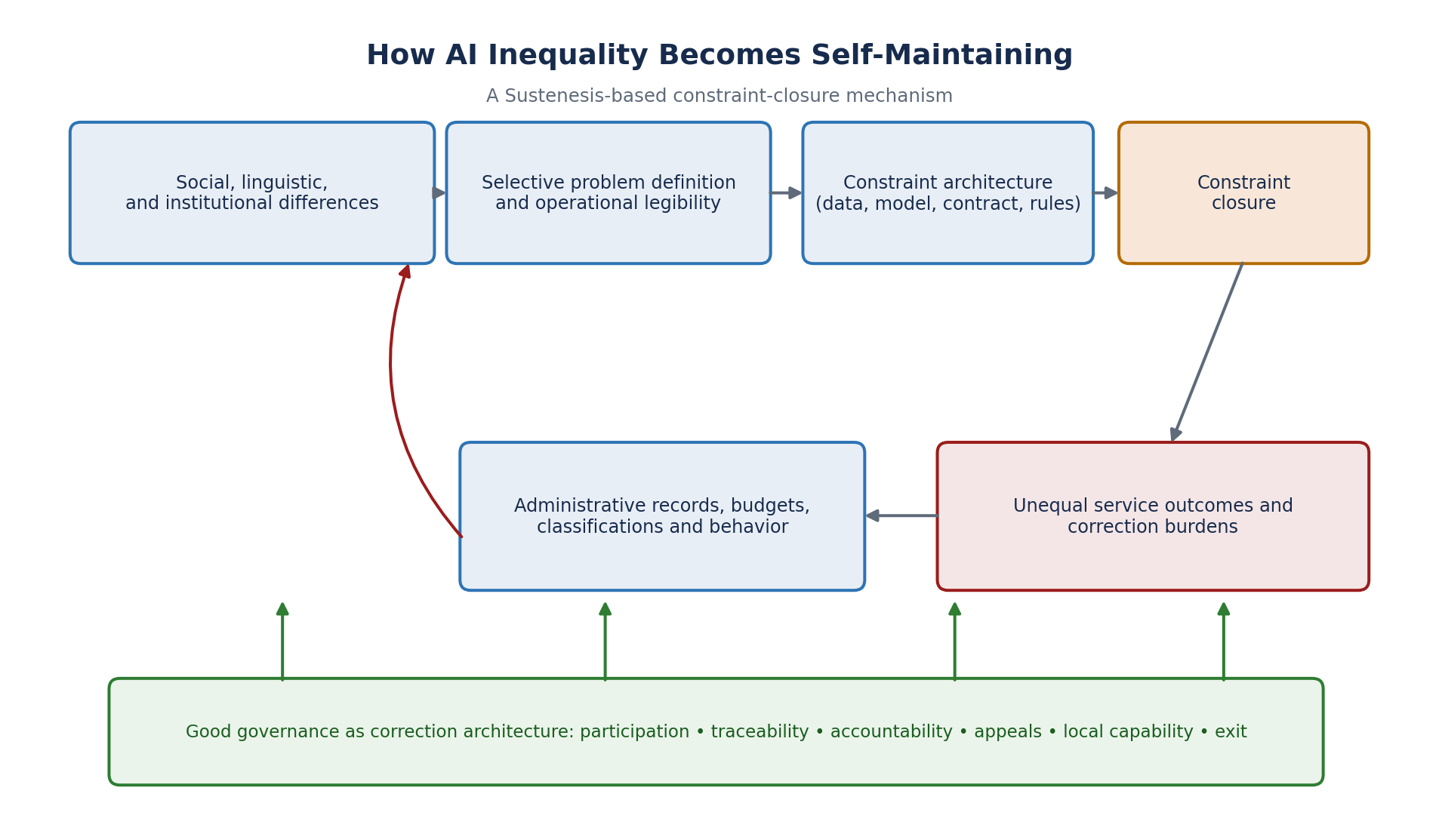
The central claim is that difference does not automatically become inequality. Differences are made selectively visible and encoded as constraints with administrative consequences. Inequality becomes a self-maintaining structure only when those constraints close and administrative outcomes repeatedly enter new data, budgets, classifications, and workflows. The principal function of good governance is therefore not to eliminate all difference or all constraint, but to prevent constraints from losing their channels of correction. Those who bear the consequences must retain the capacity to bring relevant differences back into the process of judgement and, where necessary, to change objectives, data, models, and procedures—or to stop using AI.
The article makes three theoretical contributions. First, it shifts attention from discrete instances of algorithmic bias to the formation and persistence of inequality across technical, organisational, institutional, and temporal feedback relations. Second, it extends representation beyond the composition of the civil service to problem definition, data categories, languages, model evaluation, procurement, and corrective institutions, without denying the independent value of human representation. Finally, it reorganises transparency, accountability, appeals, human oversight, and local capability as an interdependent correction architecture, explaining both why good governance matters and what practical conditions it must possess.
2. From Fragmented Risk Accounts to Persistent Inequality
2.1 Algorithmic Bias Is Not the End of the Mechanism
Research on algorithmic bias commonly begins with data representativeness, label quality, proxy variables, model error, and differences in outcomes among groups. These are all real problems. Drawing on interviews with AI practitioners in India, East and West Africa, and the United States, Sambasivan et al. (2021) show that deficiencies in upstream data work create “data cascades” whose effects accumulate through system development and deployment before entering high-stakes decisions in ways that are difficult to trace. Selbst et al. (2019) likewise caution that fairness cannot be treated as a mathematical property that can be resolved within a model in isolation, because models are always embedded in institutional objectives, organisational practices, and social classifications.
Public administration magnifies this problem. Government is not an ordinary service provider. It can establish identity, allocate benefits, set priorities, conduct inspections, affect liberty, and use public authority to give classifications real consequences. The same predictive error has a fundamentally different institutional meaning in an entertainment recommender system and in a social welfare system. In the latter, the issue is not only technical accuracy but also statutory rights, procedural justice, equal treatment, and state responsibility. Algorithmic bias therefore cannot be observed only at the point of output. Analysis must ask why a system adopts a particular problem definition, why it selects a particular proxy, who is authorised to accept the error, and who must prove that the system has harmed them.
The digital welfare field has already revealed this structure. Automation can reduce processing costs, but it can also transfer the burdens of investigation, proof, appeal, and delay onto people who are already disadvantaged. The UN Special Rapporteur on extreme poverty and human rights found in an examination of the “digital welfare state” that welfare automation can expand surveillance, exclusion, and rights harms even as it improves administrative efficiency (Alston, 2019). The Dutch SyRI case further shows that even where a system is intended to combat welfare fraud and improve efficiency, technical efficiency cannot provide sufficient legitimacy if data integration, risk classification, and contestability fail to meet human-rights and proportionality requirements (Rachovitsa & Johann, 2022). Inequality is thus not merely that one group is “miscalculated more often.” It also means that some groups are suspected more frequently, find the system harder to understand, have greater difficulty obtaining human assistance, and are less able to compel an organisation to acknowledge and correct an error.
2.2 Administrative Discretion Has Not Disappeared; It Has Been Redistributed
AI is often described as a means of reducing human bias and increasing consistency in decisions, but it does not eliminate discretion. It transfers some discretion from frontline officials to upstream sites such as problem specification, data selection, model training, threshold setting, procurement contracts, and interface design. At the same time, it creates new discretion downstream in handling exceptions, interpreting outputs, accepting recommendations, and deciding whether to override the system (Bullock, 2019; Young et al., 2019). This redistribution changes who can see how a decision is formed and who has the capacity to intervene.
Representative bureaucracy theory has traditionally examined how the social composition of the civil service affects public decisions and citizens’ trust in government. Automation does not make this question obsolete. Miller and Keiser (2021) show that public attitudes towards automated decision-making remain related to bureaucratic representation and perceived fairness. More importantly, if AI strictly limits the information frontline staff can see and the actions they can take, even officials with experience, cultural understanding, and representative standing may be unable to translate these capacities into substantive judgement. Conversely, if human confirmation is retained without the time, knowledge, authority to modify, and organisational support required to use it, the “human in the loop” may become no more than a formal endorsement of machine recommendations (Green, 2022).
Representation under AI therefore cannot ask only “who is in the office.” It must also ask who participates in defining the problem, whose data and language enter the system, who sets acceptable error rates, who has authority to review and override, and who can use an appeal to make the system learn from differences that it previously failed to see. Representation expands from a question about human composition to one running through the entire governance structure. This does not substitute data representation for human representation; it shows that each can have practical effect only when connected to real authority.
2.3 The Global North and South Are Not Geographical Labels but Relations of Constraint
Neither the “Global South” nor the “Global North” is an internally homogeneous geographical entity. High-income countries contain substantial class, ethnic, and regional differences, while developing countries possess diverse technical capabilities, institutional innovations, and local knowledge. The terms are used here to describe a recurring structural relation within AI value chains: infrastructure, models, capital, standards, and intellectual property are concentrated in a small number of centres, while data collection, content moderation, low-cost annotation, experimental risk, and the costs of institutional adaptation are distributed more heavily across peripheral regions.
This relation appears not only as unequal access to technology but also as unequal authority to set constraints. Even where a local government can procure a globally leading model, it may be unable to inspect the training data, change core parameters, understand language errors, preserve local data sovereignty, or continue operating a service if the vendor withdraws. A lack of compute and skilled personnel limits the capacity to adopt AI, but the deeper question is whether adoption leaves a government with the capacity for independent judgement, validation, bargaining, exit, and correction. Birhane (2020) describes the relation created by external technological monopolies, data extraction, and imported values as algorithmic colonisation. Mohamed et al. (2020) argue that decolonial AI must bring power, history, and epistemic diversity back into technical practice rather than treating marginalised communities merely as data sources waiting to be included.
Language hierarchy offers one of the clearest examples. The world has more than 7,000 languages, yet resources and research in natural language processing have long been concentrated in a very small number of high-resource languages (Joshi et al., 2020). Blasi et al.’s (2022) comparison of language-technology performance across thousands of languages further shows that resource disparities systematically become performance disparities. As public services rely increasingly on chatbots, automated translation, document classification, and large language models, disparities in language capability translate directly into disparities in service access, precision of expression, and the opportunity to be understood. Adding data for low-resource languages may help, but it can also become a new round of extraction if data collection lacks community control, purpose limitation, and benefit-sharing. Representing difference does not mean that difference must be datafied without limit. Privacy, collective data rights, and the right not to be encoded remain necessary constraints.
3. Sustenesis Theory and Its Theoretical Boundary in Public Administration
3.1 Difference, Constraint, and Sustained Coherence
Sustenesis Theory understands existence as the formation and maintenance of structure under conditions of change. Its basic relation can be summarised as follows: Constraint organises Difference into Sustained Coherence. Difference denotes distinctions within a structure and between a structure and its environment that cannot be eliminated in advance. Without difference, there can be no relation, change, or structure. Constraint determines which relations, pathways, and changes can continue to exist. Constraint is not merely a repressive force; it is also a condition of structural formation. Sustained Coherence is neither static stability nor the absence of conflict, but the capacity of differentiated elements to maintain identifiable and effective organisational relations through constraint, testing, and adjustment (Chen, 2026).
Correction and effective operation are important here, but they are not fourth and fifth basic concepts alongside Difference, Constraint, and Sustained Coherence. Correction describes the process by which a structure restores or adjusts relations in response to deviation, failure, and environmental change. Effective operation means that coherence cannot remain purely linguistic or internal to imagination; it must hold in practice under relevant environmental conditions and constraints. A structure may persist by changing, or lose its original coherence by refusing to change.
When this framework is applied to public-sector AI, the unit of analysis cannot be a single algorithm. A public AI system includes at least policy objectives, legal authority, administrative rules, training and operational data, models, interfaces, procurement relationships, infrastructure, public officials, vendors, service users, oversight bodies, and appeal procedures. The model is only one node capable of reinforcing or changing other relations. Nor can a system be said to function well merely because the model is accurate or departmental processes run smoothly. The relevant question is whether the governance structure continues to maintain rights, accessibility, accountability, and legitimacy across groups, places, and timescales.
| Sustenesis concept | Strict meaning | Analytical focus in public-sector AI governance |
|---|---|---|
| Difference | Distinctions among populations, languages, knowledge, interests, institutions, and capabilities that do not disappear automatically. Difference is not itself a defect or an inequality. | Which differences acquire operational legibility, and which are compressed or excluded in problem definitions, data, and processes. |
| Constraint | Conditions that delimit feasible relations and pathways of change. Constraints both enable formation and impose limits. | Who sets and can modify law, data rules, models, metrics, procurement, infrastructure, administrative procedures, and power relations. |
| Sustained Coherence | Differentiated elements maintain identifiable and effective organisational relations through change, testing, and adjustment. This does not mean stasis, uniformity, or legitimacy. | Whether operation across technical, organisational, and social scales continues to preserve rights, accessibility, accountability, and correction capacity. |
| Correction | The process through which Sustained Coherence is tested, restored, and adjusted; not a new basic concept. | Whether errors can be discovered and contested, and whether they can trigger individual redress, institutional modification, suspension, or exit. |
3.2 Persistence Is Not Good Governance
It must be made explicit that Sustenesis Theory first explains how structures form and persist. It does not declare a structure true, good, or legitimate merely because that structure can be maintained. Discriminatory institutions, closed bureaucratic systems, and exploitative relations may all sustain internal coherence for considerable periods. Their persistence shows only that the constraints supporting them remain operative; it does not show that those structures deserve to be maintained.
Normative judgement in public administration continues to derive from democratic values, human rights, the rule of law, procedural justice, the public interest, and development goals. “Sustained coherence with legitimacy,” as used here, is a normative qualification introduced when Sustenesis Theory is applied to public administration; it is not an additional basic concept of the theory. It requires public services not merely to remain operational, but to remain open to external testing, challenges from affected people, and evaluation against public values. A department may improve its internal efficiency by shifting error, delay, and evidentiary burdens onto service users, but coherence at the departmental scale may then be purchased at the expense of rights and trust at the societal scale.
This distinction also changes how the objective of governance is understood. What good governance must sustain is not every AI subsystem already deployed, but the legitimate operation of public services as a whole. If a system can function only by excluding local differences, suppressing appeals, or continually transferring costs, stopping it may be the correction necessary to sustain public governance. Correction cannot be reduced to tuning model parameters. It must allow the problem to be redefined, categories to be changed, procurement relationships and administrative rules to be modified, and, where necessary, automation to be abandoned.
3.3 From Ethical Principles to a Correction Architecture
Global AI ethics guidelines have achieved a high degree of agreement around principles of fairness, transparency, accountability, privacy, and human oversight (Jobin et al., 2019; UNESCO, 2021). The problem is that principles do not automatically produce implementing actors, information, authority, budgets, and remedies. Mittelstadt (2019) argues that AI ethics cannot simply reproduce the professional institutional foundations of medical ethics, because AI development lacks an equally stable structure of professional responsibility, oversight, and common purpose. The public sector does possess legal and administrative systems of responsibility, but complex procurement chains and technical opacity can still disperse accountability.
What Sustenesis Theory contributes here is not another list of principles, but a relational account. Transparency provides the information needed to identify constraints. Accountability determines who must explain and bear consequences. Participation and representation allow excluded differences to re-enter problem definition. Appeals provide a route for triggering correction. Audit and human oversight identify operational deviation. Rights to modify and exit, together with budgets and local capability, make correction possible in practice. No element is sufficient on its own. Transparency without appeal merely makes a problem visible. Appeal without anyone authorised to modify the model or procedure merely records the problem. Human review without officials able to understand or override a recommendation is merely formal oversight.
4. From Difference to Constraint Closure
4.1 Operational Legibility
Public organisations cannot incorporate the full complexity of society into an administrative system. Governance necessarily selects, through categories, indicators, forms, languages, and procedures, which differences have administrative relevance. This article uses operational legibility to describe whether a difference can enter problem definition, data categories, model evaluation criteria, and workflows. This does not require unlimited data collection. It requires an organisation to explain which differences it treats as relevant, which it disregards, and what consequences that choice has for rights.
Where a large gap exists between the relevant differences in an actual administrative environment and those a system can represent, a model may fail persistently for particular groups even if its aggregate accuracy is high. Minority languages, non-standard addresses, informal employment, multigenerational households, disability-related modes of communication, and local systems of evidence may all lose visibility through standardisation. The more constraining system outputs are on administrative decisions, the more serious the consequences of this representational gap become.
Proposition 1: Difference legibility. The larger the gap between relevant differences in the administrative environment and the differences represented in problem definitions, training and validation data, classification systems, and evaluation criteria, the more likely AI is to generate systematic disparate impacts; the more constraining AI outputs are on administrative decisions, the stronger this relationship will be.
4.2 Constraint Architecture and Constraint Concentration
Constraints in AI governance include data rules, model architectures, performance metrics, thresholds, laws, procurement contracts, infrastructure, budgets, administrative procedures, and power relations. They enable systems to operate while also limiting the problems systems can see and the actions they can take. Not all constraints should be treated as negative. Privacy protection, due process, audit, data minimisation, and prohibitions on discrimination are also constraints, and they are necessary conditions of legitimate public-sector AI.
The central questions are who sets the constraints, who can understand them, and who can modify them. When a government procures commercial AI, technical control is often concentrated in the vendor while legal responsibility and public pressure remain with government. Local institutions may be able to configure only a narrow set of parameters, may be unable to validate the model independently, and may have no route of exit beyond the contract, proprietary interface, or infrastructure dependency. Countries and regions with fewer resources are more likely to accept default standards formed in external markets because independent development and continuing evaluation are too costly. Technological access may then appear to narrow the gap even as the gap in constraint-setting authority grows.
Proposition 2: Constraint concentration. The more control over data, models, technical standards, and procurement regimes is concentrated, and the weaker the capacity of user jurisdictions to validate, adjust, audit, and exit systems independently, the greater the degree of constraint closure.
4.3 Constraint Closure
Constraint closure is the process through which technical and institutional choices that were originally revisable progressively lose effective channels of correction. It may result from commercial secrecy, model complexity, untraceable data, vendor lock-in, dispersed responsibility, absent appeal mechanisms, limited staff capability, or budget dependence. Closure does not mean that a system cannot change at all. It means that the information, authority, and resources required to change it are concentrated far from the people affected.
Constraint closure gives initial choices the appearance of objective facts. A risk label may originate in historical enforcement data; a performance metric may reflect only what is easy to measure; a language model may be treated as “naturally” suited to particular populations because it performs better in high-resource languages. As these outputs enter formal processes, public officials, budgets, and citizen behaviour adjust around them. The system thus does more than apply rules: it begins to shape the data environment later treated as factual.
Proposition 3: Constraint closure. Constraint closure mediates the relationship between pre-existing disparities in representation or capability and persistent administrative inequality because it simultaneously weakens error detection, public contestation, institutional modification, and effective redress.
4.4 Feedback Maintenance
AI decisions generate new administrative records, influence who is investigated, who receives resources, and which cases receive priority, and also change the work habits of public officials and citizens’ willingness to apply for services. If high-risk groups are inspected more often, the number of records associated with them increases further. If service quality is lower in a particular language, users may reduce their use, and subsequently receive fewer resources because of apparent “low demand.” Initial differences thereby re-enter data, budgets, and processes through outcome feedback and become self-reinforcing.
This is also why short-term assessment often fails. Pre-deployment accuracy and one-off fairness tests cannot capture how a system changes its own environment. The proper unit of evaluation must include the cycle among model outputs, administrative responses, service-user behaviour, resource reallocation, and subsequent data. It must also extend across enough time to observe who obtains correction, who withdraws from services, and which errors are absorbed into institutional routines.
Proposition 4: Feedback maintenance. The more extensively AI outcomes enter subsequent administrative records, training labels, budget allocations, risk classifications, staff routines, and public behaviour, the more likely initial representational biases and resource disparities are to become self-reinforcing.
5. The Cross-Scalar Formation of Global Inequality
An AI system can increase coherence at one scale while creating disorder at another. A central department may achieve more uniform case processing and lower costs while local institutions bear the complexity of adaptation. A vendor may realise economies of scale through a standardised model while users of minority languages bear the time required for repeated explanation and appeal. High-income countries may improve model capability using global data and labour while low-income regions receive neither corresponding control over the model nor a reciprocal share of the benefits. This can be understood as the cross-scalar transfer of correction burdens.
Correction capacity consists of the information, standing, authority, expertise, and resources needed to detect errors, obtain explanations, raise challenges, modify models or processes, suspend systems, and provide redress. Correction burden is the time, expense, risk, and cognitive cost involved in identifying error, proving harm, gaining access to an appeal, and waiting for correction. Global inequality often does not result from the complete absence of correction mechanisms. Instead, correction capacity is concentrated in technical centres, central departments, and vendors, while correction burdens are dispersed among local governments, frontline staff, and service users.
Transparency is conditional within this structure. Publishing model documentation, data sources, or audit findings can improve visibility, but it does not automatically produce change where affected people lack standing to appeal, accessible procedures, an identifiable responsible actor, practical authority to modify the system, or resources for redress. Feng and Chandra’s (2026) mixed-methods study of Chinese citizens finds that public concerns extend beyond technical explanation to procurement accountability, institutional transparency, auditing, and administrative appeal. This accords with public accountability theory: information, discussion, and consequences must form a continuous relation before accountability becomes effective (Bovens, 2007; Busuioc, 2021).
Proposition 5: The transparency condition. With transparency held constant, transparency alone is unlikely to reduce inequality where affected people lack standing to appeal, accessible procedures, a clearly responsible actor, practical authority to modify the system, or resources for redress.
Representation is subject to the same condition. If frontline officials can perceive cultural, household, or local differences ignored by a model but lack authority to review, override, and formally record objections, their representative capacity is unlikely to have substantive effect. Conversely, increasing the diversity of upstream technical personnel cannot substitute for service-user participation and public responsibility. Representation must be connected across problem definition, data, models, administrative decisions, and correction procedures.
Proposition 6: Representative bureaucracy. The more strictly AI limits the judgement of frontline officials, the less readily the demographic representativeness of the civil service can be translated into substantive representation; representative mechanisms must extend upstream to problem definition and procurement and downstream to authority for review, override, and correction.
Proposition 7: The distribution of correction capacity. The more correction capacity is distributed to the local institutions, professionals, and affected groups using or subject to AI—and the lower the burdens of appeal and correction—the more likely effective operation at the model and departmental levels is to remain coherent with rights, accessibility, and legitimacy at the levels of public service and society.
6. Good Governance as a Correction Architecture
Good governance is not a layer of abstract ethics added to an AI system. It is the institutional design of how the system’s constraints are formed, operated, and changed. Channels of correction must remain open in at least six locations.
First, problem definition and participation. Before deciding to use AI, a public organisation should state the problem it seeks to address, why existing procedures are inadequate, which groups may be affected, and whether automation would disguise a political or distributive problem as one of technical optimisation. Participation cannot be deferred until a system is about to be launched. Local institutions, frontline officials, and service users must be able to influence the problem definition, categories, and criteria of success.
Second, representational adequacy. Data and language testing should assess not only overall accuracy but also whether relevant groups, local settings, and minority languages possess sufficient operational legibility. At the same time, representational adequacy must be combined with data minimisation, purpose limitation, privacy, and community control so that fairness is not used to justify unnecessary data extraction. Where the system cannot serve a group reliably, it should state its scope limitations and preserve non-digital channels.
Third, the traceability and legitimacy of constraints. Public institutions need to record objectives, proxy variables, thresholds, model versions, vendor responsibilities, points of human intervention, and known limitations. Publishing source code is neither necessary nor sufficient in every context, but government must retain the rights to independent evaluation, audit, modification, suspension, and exit. Procurement contracts must not use commercial confidentiality to eliminate public accountability, and model updates must not bypass reassessment.
Fourth, accountability continuity. Every AI use case with administrative consequences should have a clearly identified public actor responsible for it. Vendors, data teams, operational units, frontline personnel, and oversight bodies may carry different duties, but responsibility cannot circulate among them until it disappears. A government’s decision to adopt a system is itself an administrative act that requires explanation and carries consequences. Knowledge production and technical execution can be distributed, but responsibility for allowing outputs to enter public decisions must remain clearly located in human institutions and positions with authority.
Fifth, contestability and effective redress. Service users need to know whether AI has influenced a decision, be able to obtain reasons in an intelligible form, and use a low-cost procedure to request human review. Appeal bodies must be able not only to change individual cases but also to detect repeated errors and trigger structural correction. Time limits for correction, compensation, restoration of eligibility, and suspension of automated execution should be specified according to risk. Otherwise, appeal simply transfers system costs back to affected people.
Sixth, local capability and reciprocal distribution. Developing countries and local institutions need more than the opportunity to purchase and use AI. They also need capability in local-language data governance, independent evaluation, technical maintenance, public procurement negotiation, legal oversight, and viable alternatives for exit. Value created from local data and public resources should return locally through capability-building, public infrastructure, open standards, or reasonable benefit-sharing arrangements. Inclusion cannot mean only that more regions become platform users or data suppliers.
Together, these six locations form a correction architecture. They address the entry of difference, the formation of constraints, operational monitoring, the attribution of responsibility, the triggering of correction, and the distribution of capacity. Governance remains declaratory where principles exist without these relations. Where the relations operate continuously, AI can become an aid to public judgement rather than a substitute for decision-making that conceals administrative responsibility and social difference.
| Governance location | Failure mechanism addressed | Minimum institutional conditions and observable indicators |
|---|---|---|
| Problem definition and participation | Political and distributive problems are reduced to technical optimisation; local knowledge cannot enter the objective. | Participation by affected groups and frontline personnel; public justification for use and disclosure of non-AI alternatives; contestable success metrics. |
| Representational adequacy | Relevant groups, languages, and local environments lack operational legibility. | Group and language coverage testing; scope limitations; non-digital channels; data minimisation, purpose limitation, and community control. |
| Constraint traceability | Models, metrics, contracts, and update processes create invisible or proprietary constraints. | Records of versions, proxies, thresholds, and responsibility; rights to independent audit; modification, suspension, and exit clauses; reassessment after updates. |
| Accountability continuity | Responsibility disappears among vendors, data teams, operational units, and frontline personnel. | A clearly identified responsible public actor; duties to explain and intervene; a complete audit trail; administrative responsibility cannot be avoided through outsourcing. |
| Appeal and redress | Affected people bear the costs of proof, waiting, and correction, while individual errors cannot change the system. | Low-cost, multilingual appeals; authority for human review and override; correction time limits; compensation and restoration of eligibility; repeated errors trigger structural review. |
| Local capability and reciprocity | Technical centres hold correction capacity while localities bear dependence, adaptation, and risk. | Local evaluation and maintenance expertise; public procurement bargaining capacity; open standards; return of data-derived value; alternative vendors and exit capacity. |
7. Contributions to Public Administration Theory
7.1 A Limited Extension of Representative Bureaucracy
This article does not propose replacing representative bureaucracy with “data representation.” Human experience, identity, trust, and active representation retain a significance that cannot be replaced by technical categories. The extension proposed here is that AI changes the channels through which representation can operate. A civil service may be diverse, but if problem definitions, data structures, and interfaces have already excluded relevant differences, and frontline staff lack authority to change decisions, human representation is interrupted by technical constraints. Research on representation should therefore examine how personnel composition, system representation, and correction authority are connected.
7.2 Repositioning Administrative Discretion
The “artificial discretion” framework has shown that machines can exercise different degrees of judgement depending on task specificity and environmental complexity (Young et al., 2019). This article further argues that the central question of discretion is not merely whether a human or a machine makes the final decision, but which upstream choices are fixed as constraints and whether those constraints can be identified and changed downstream. A nominal final human signature does not necessarily constitute genuine human discretion. Substantive discretion requires the capacity to redefine the problem, reject a proxy, record dissent, and trigger structural modification.
7.3 A Structural Account of Public Accountability
Public accountability ordinarily involves an actor explaining conduct, being questioned in a forum, and facing consequences (Bovens, 2007). AI extends this relation across data, models, vendors, and administrative departments, making discontinuities in information and responsibility more likely. The accountability continuity proposed here can be understood as continuity of constraints: from problem definition through data, models, procurement, deployment, and appeal, every constraint with administrative consequences should be traceable to a responsible actor who is obliged to explain it, has the capacity to intervene, and must bear consequences. Explainable AI is only one informational link in this relation and cannot substitute for institutional responsibility.
7.4 Advancing Development Administration
AI development policy often understands the gap as a lack of infrastructure and skills, making broader access to technology its main objective. Access matters, but it can widen the capability gap if accompanied by stronger vendor lock-in, data outflows, and dependence on external standards. Development administration needs to distinguish adoption capacity from correction capacity. Genuine capability consists not only of deploying a system but also of evaluating, negotiating, adapting, auditing, suspending, and replacing it. This shift moves local capacity-building from an adjunct to technology diffusion to a core condition of good AI governance.
8. Research Agenda and Operationalisation
This is a conceptual article, and its propositions require testing across countries, policy domains, and time. The most suitable empirical objects are AI systems used for eligibility determination, resource allocation, risk scoring, enforcement, case triage, and access to public services, particularly where substantial capability disparities exist between technology providers and user jurisdictions. Generative AI falls within the article’s scope only when it enters these administrative decisions and workflows.
Constraint closure is first a dynamic process concept and should not be treated as a static independent variable detached from temporal sequence. At this stage, comparative case study and process tracing offer the most appropriate empirical approaches. Research can trace problem definition, contractual terms, model evaluation, work interfaces, human review, individual appeals, and system modification from procurement through appeal. It can identify when relevant differences are excluded, when technical and administrative choices acquire constraining force, where dissent ceases to have effect, and how repeated outcomes return to new records, classifications, and budgets. Cross-national, multi-case studies can also compare the degree of constraint closure and the pathways of correction when identical or similar commercial systems enter different institutional and linguistic environments.
Such research must distinguish process evidence from outcome indicators. Process evidence identifies whether and how constraints have closed, including policy and procurement documents, contractual modification rights, model-version records, minutes and records of dissent, audit materials, appeal files, human overrides, and system-suspension records. Outcome indicators assess the distributive consequences of closure, including group error rates, service abandonment rates, appeal success, correction time, evidentiary burdens, and cost distribution. Outcome disparity alone cannot prove constraint closure. Complete mechanism evidence requires connecting the outcome to prior constraint formation, blocked contestation, and administrative feedback.
On this basis, the article’s core concepts can be operationalised initially through sets of observable manifestations. Operational legibility can be observed in the coverage of relevant groups and languages in training and validation data, whether categories can express local differences, and whether stakeholders participate in problem definition. Constraint concentration can be observed in vendor dependence, rights of access to models and data, contractual modification rights, rights to independent audit, and exit costs. Constraint closure can be observed in whether dissent can enter formal records, model updates are reassessed, appeals can trigger system change, and local institutions possess authority to suspend. Correction capacity can be observed in responsible actors, skilled personnel, budgets, audit tools, review authority, and resources for redress. Correction burden can be observed in the time, expense, proof requirements, language and digital barriers, and risks of retaliation or loss of service associated with appeal. Cross-scalar coherence requires comparing the benefits obtained and costs borne by vendors, central departments, local implementers, and service users.
These observable manifestations should not yet be forced into a single index. Large-sample cross-national research should follow the accumulation of case studies, first establishing whether indicators carry the same meaning in different institutional settings and addressing the difficulty of obtaining procurement contracts, model updates, and appeal records. A more feasible quantitative path is to construct separate component indicators for representational adequacy, constraint concentration, contestability, and correction capacity, and then test their relationships with service outcomes and the distribution of burdens. Surveys and experiments can also test how variations in transparency, responsible actors, human authority, and appeal design affect public trust and willingness to use services, but such studies cannot replace the tracing of real institutional processes.
This research design also allows the article’s propositions to be falsified. If relevant differences continue to enter a system over time, errors produce timely structural change, and distributive outcomes do not deteriorate under highly concentrated constraints and weak correction capacity, the explanatory scope of constraint closure would need to be narrowed or revised. Conversely, if inequality persists when transparency increases but appeals, modification rights, and resources remain unchanged, the transparency-condition proposition would receive support. A conceptual framework can become an effective theory of public administration only when it enters a process of comparison, testing, and revision of this kind.
9. Discussion
As a relatively new philosophical framework, Sustenesis Theory needs to be clearly distinguished from established approaches such as sociotechnical systems, institutional feedback, and path dependence. The relevant distinction lies not in whether the concepts bear different names, but in what each theory explains and where its explanatory boundaries lie.
Path dependence primarily explains how early choices constrain subsequent options through increasing returns, switching costs, and institutional lock-in (Pierson, 2000). It can explain why a technical or administrative arrangement becomes increasingly difficult to exit, but it asks less often which social and linguistic differences failed to acquire operational legibility at an early stage, and it does not systematically explain whether affected people possess institutional channels capable of reopening constraints. Sociotechnical systems research reveals the interdependence of technology, organisation, institutions, and people, but a holistic perspective does not by itself provide a specific mechanism explaining why inequality persists. Institutional isomorphism explains why public organisations adopt similar AI institutions and technologies under coercive, mimetic, and professional pressures (DiMaggio & Powell, 1983), but it is concerned primarily with convergence among organisations and cannot alone explain why similar systems generate different exclusionary outcomes and correction capacities in different local environments.
The added value of Sustenesis Theory lies not in replacing these theories but in connecting three processes usually studied separately: how differences are selectively made visible, how technical and institutional choices are encoded and undergo constraint closure, and how administrative feedback and the distribution of correction capacity make inequality persistent. This mechanism explains not only why an institution endures, but what is being perpetuated, which differences are excluded, and who still has the capacity to alter established constraints.
Constraint closure can include path-dependent effects, but it cannot be reduced to path dependence. Path dependence addresses how choices become difficult to reverse. Constraint closure further asks whether that irreversibility results from informational invisibility, concentrated authority, vendor lock-in, ineffective appeals, and insufficient local capability, and whether those conditions can be changed through a correction architecture. The objects of empirical research proposed in this article are not all the philosophical claims of Sustenesis Theory, but the constraint-closure mechanism derived from the framework, the seven propositions, and their observable manifestations. This preserves the unified analytical logic provided by Sustenesis Theory while allowing the article to enter a comparable and revisable dialogue with established public administration theory.
A second theoretical boundary concerns the relation between Sustained Coherence and normative value. Sustained Coherence must not equate stability with goodness. The article has explicitly separated explanation from normative judgement. An unequal structure can maintain Sustained Coherence, and that is precisely why it must be explained and disrupted. Democratic values, human rights, the rule of law, and the public interest supply the normative standards for public administration. Sustenesis Theory helps identify which relations maintain the status quo, where channels of correction have closed, and which constraints must be reached for change to occur.
A third theoretical boundary concerns how the Global South is understood. It cannot be represented as passive, homogeneous, and incapable. The article treats North–South relations as relations of power, resources, and technological dependence rather than geographical essences. Local knowledge, institutional innovation, and social agency are not merely raw materials to be “included” in large models. They should carry rights to define problems, set boundaries, and refuse inappropriate technology. Local capability-building should not reproduce central models, but strengthen the capacity of local actors to form, test, and revise their own governance structures.
Finally, more representative data does not necessarily produce fairer outcomes. It may expand surveillance and extraction, or force differences that cannot be quantified into fixed categories. Operational legibility must therefore coexist with the right not to be encoded. Good governance must determine which differences need to enter administrative judgement, which data should not be collected, and when public service should instead be maintained through interpersonal communication, local discretion, or non-digital channels.
10. Conclusion
The fundamental governance question for public-sector AI is not whether all difference can be eliminated or a completely unbiased model can be found. It is whose differences can enter a system, who has authority to set constraints, who benefits from those constraints, who bears the costs of error and correction, and whether the constraints remain open to testing and change in actual administrative operation.
AI inequality persists because social and linguistic differences are represented selectively, written into models, metrics, contracts, and administrative procedures, and then subjected to constraint closure through technical complexity, concentrated power, vendor dependence, and insufficient correction capacity. Once administrative outcomes enter new records, budgets, and behavioural feedback, the initial choices cease to be merely design choices. They become an institutional reality capable of maintaining itself.
Good governance cannot therefore stop at declarations of fairness, transparency, and accountability. It must become an institutionalised correction architecture that allows difference to re-enter judgement, keeps constraints traceable and revisable, prevents responsibility from disappearing along the technical chain, and distributes correction capacity to the local institutions, public officials, and service users who actually bear the risks. AI can become an important aid to public judgement, but it cannot substitute for public responsibility.
Sustenesis Theory does not offer a prior guarantee of justice. It offers a method for identifying structure. It asks researchers and public organisations to continue examining which differences are being organised, which constraints are forming, what kind of coherence is being maintained, and who has the capacity to change that coherence when it loses public legitimacy. The long-term quality of AI governance ultimately depends not on whether a system can continue to operate, but on whether public governance can continue to correct itself.
References
- Alon-Barkat, S., & Busuioc, M. (2023). Human–AI interactions in public sector decision making: “Automation bias” and “selective adherence” to algorithmic advice. Journal of Public Administration Research and Theory, 33(1), 153–169. https://doi.org/10.1093/jopart/muac007
- Alston, P. (2019). Report of the Special Rapporteur on extreme poverty and human rights: Digital welfare states (UN Doc. A/74/493). United Nations. Report page.
- Birhane, A. (2020). Algorithmic colonization of Africa. SCRIPTed, 17(2), 389–409. https://doi.org/10.2966/scrip.170220.389
- Blasi, D., Anastasopoulos, A., & Neubig, G. (2022). Systematic inequalities in language technology performance across the world’s languages. In Proceedings of the 60th Annual Meeting of the Association for Computational Linguistics (pp. 5486–5505). Association for Computational Linguistics. https://doi.org/10.18653/v1/2022.acl-long.376
- Bovens, M. (2007). Analysing and assessing accountability: A conceptual framework. European Law Journal, 13(4), 447–468. https://doi.org/10.1111/j.1468-0386.2007.00378.x
- Bovens, M., & Zouridis, S. (2002). From street-level to system-level bureaucracies: How information and communication technology is transforming administrative discretion and constitutional control. Public Administration Review, 62(2), 174–184. https://doi.org/10.1111/0033-3352.00168
- Bullock, J. B. (2019). Artificial intelligence, discretion, and bureaucracy. The American Review of Public Administration, 49(7), 751–761. https://doi.org/10.1177/0275074019856123
- Busuioc, M. (2021). Accountable artificial intelligence: Holding algorithms to account. Public Administration Review, 81(5), 825–836. https://doi.org/10.1111/puar.13293
- Chandra, Y., & Feng, N. (2026). Algorithms for a new season? Mapping a decade of research on the artificial intelligence-driven digital transformation of public administration. Public Management Review, 28(3), 620–654. https://doi.org/10.1080/14719037.2025.2450680
- Chen, G. (2026). Sustenesis Theory. Sustenesis.com. https://sustenesis.com/
- Chen, Y.-C., Ahn, M. J., & Wang, Y.-F. (2023). Artificial intelligence and public values: Value impacts and governance in the public sector. Sustainability, 15(6), 4796. https://doi.org/10.3390/su15064796
- DiMaggio, P. J., & Powell, W. W. (1983). The iron cage revisited: Institutional isomorphism and collective rationality in organizational fields. American Sociological Review, 48(2), 147–160. https://doi.org/10.2307/2095101
- Feng, N., & Chandra, Y. (2026). Accountability in government use of AI: Citizen concerns and preferences. Public Administration. Advance online publication. https://doi.org/10.1111/padm.70030
- Green, B. (2022). The flaws of policies requiring human oversight of government algorithms. Computer Law & Security Review, 45, 105681. https://doi.org/10.1016/j.clsr.2022.105681
- Jobin, A., Ienca, M., & Vayena, E. (2019). The global landscape of AI ethics guidelines. Nature Machine Intelligence, 1, 389–399. https://doi.org/10.1038/s42256-019-0088-2
- Joshi, P., Santy, S., Budhiraja, A., Bali, K., & Choudhury, M. (2020). The state and fate of linguistic diversity and inclusion in the NLP world. In Proceedings of the 58th Annual Meeting of the Association for Computational Linguistics (pp. 6282–6293). Association for Computational Linguistics. https://doi.org/10.18653/v1/2020.acl-main.560
- König, P. D., & Wenzelburger, G. (2021). The legitimacy gap of algorithmic decision-making in the public sector: Why it arises and how to address it. Technology in Society, 67, 101688. https://doi.org/10.1016/j.techsoc.2021.101688
- Miller, S. M., & Keiser, L. R. (2021). Representative bureaucracy and attitudes toward automated decision making. Journal of Public Administration Research and Theory, 31(1), 150–165. https://doi.org/10.1093/jopart/muaa019
- Mittelstadt, B. (2019). Principles alone cannot guarantee ethical AI. Nature Machine Intelligence, 1, 501–507. https://doi.org/10.1038/s42256-019-0114-4
- Mohamed, S., Png, M.-T., & Isaac, W. (2020). Decolonial AI: Decolonial theory as sociotechnical foresight in artificial intelligence. Philosophy & Technology, 33(4), 659–684. https://doi.org/10.1007/s13347-020-00405-8
- OECD. (2026). Digital Government Outlook 2026: Adopting and governing AI in government. OECD Publishing. Publication page.
- Pierson, P. (2000). Increasing returns, path dependence, and the study of politics. American Political Science Review, 94(2), 251–267. https://doi.org/10.2307/2586011
- Rachovitsa, A., & Johann, N. (2022). The human rights implications of the use of AI in the digital welfare state: Lessons learned from the Dutch SyRI case. Human Rights Law Review, 22(2), ngac010. https://doi.org/10.1093/hrlr/ngac010
- Sambasivan, N., Kapania, S., Highfill, H., Akrong, D., Paritosh, P., & Aroyo, L. M. (2021). “Everyone wants to do the model work, not the data work”: Data cascades in high-stakes AI. In Proceedings of the 2021 CHI Conference on Human Factors in Computing Systems (Article 39, pp. 1–15). ACM. https://doi.org/10.1145/3411764.3445518
- Schiff, D. S., Schiff, K. J., & Pierson, P. (2022). Assessing public value failure in government adoption of artificial intelligence. Public Administration, 100(3), 653–673. https://doi.org/10.1111/padm.12742
- Selbst, A. D., boyd, d., Friedler, S. A., Venkatasubramanian, S., & Vertesi, J. (2019). Fairness and abstraction in sociotechnical systems. In Proceedings of the 2019 Conference on Fairness, Accountability, and Transparency (pp. 59–68). ACM. https://doi.org/10.1145/3287560.3287598
- UNCTAD. (2025). Technology and Innovation Report 2025: Inclusive artificial intelligence for development. United Nations Conference on Trade and Development. Publication page.
- UNESCO. (2021). Recommendation on the ethics of artificial intelligence. UNESCO. Publication page.
- World Bank. (2025). Digital Progress and Trends Report 2025: Strengthening AI foundations. World Bank. Publication page.
- Wirtz, B. W., Weyerer, J. C., & Geyer, C. (2019). Artificial intelligence and the public sector—Applications and challenges. International Journal of Public Administration, 42(7), 596–615. https://doi.org/10.1080/01900692.2018.1498103
- Young, M. M., Bullock, J. B., & Lecy, J. D. (2019). Artificial discretion as a tool of governance: A framework for understanding the impact of artificial intelligence on public administration. Perspectives on Public Management and Governance, 2(4), 301–313. https://doi.org/10.1093/ppmgov/gvz014
- Zuiderwijk, A., Chen, Y.-C., & Salem, F. (2021). Implications of the use of artificial intelligence in public governance: A systematic literature review and a research agenda. Government Information Quarterly, 38(3), 101577. https://doi.org/10.1016/j.giq.2021.101577